
Getting around Dénia
The centre is compact and flat, so most errands are a walk or a short bike ride. For the beaches, the coast and nearby towns, here is how to use the bike lanes, the town buses, the TRAM and the car.
Quick answers
Do you need a car to live in Dénia?
Not if you live in the centre, the old town or Baix la Mar. Shops, banks, the market, the port and town beaches are all within walking distance. In Les Marines, Les Rotes or on the Montgó slopes, a car or e-bike makes daily life much easier.
Is Dénia good for cycling?
Yes. There are marked bike lanes through town, a flat traffic-free greenway inland, and mountain roads that draw professional cyclists for winter training.
Is there a town bus?
Yes. BusDénia runs five urban lines to the hospital, Les Marines, Les Rotes, Costa Calma and around the centre. A single ticket costs around €1.65.
Can I use the TRAM to visit nearby towns?
Yes. Line 9 connects Dénia with Gata de Gorgos, Teulada, Benissa, Calp, Altea and Benidorm, and makes an easy day out without parking worries.
On foot
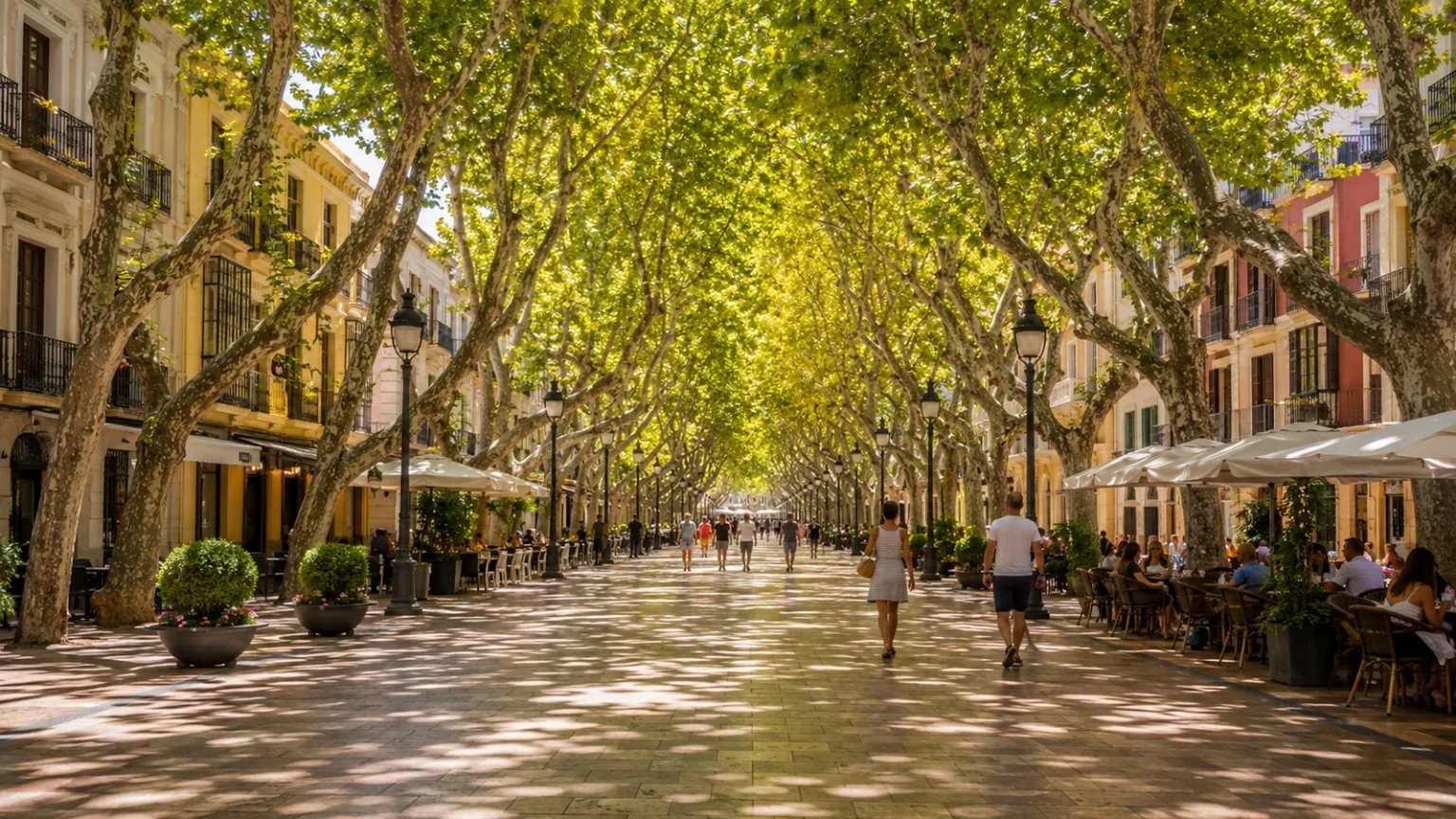
Start on Marqués de Campo, the boulevard under a canopy of plane trees, then walk down to the palm-lined Esplanada de Cervantes by the marina. Together they are the town’s main promenade.
Three walks worth knowing:
- Les Bassetes to the North Jetty: a flat 3.3 km seaside walk past the Portet marina and the ferry terminal, ending at the green lighthouse almost 500 m out to sea.
- Les Rotes seafront: about 3 km from Marineta Cassiana beach to Cala de l’Aigua Dolça, along rocks and clear water. Our Les Rotes guide
- The old town: follow our self-guided walking tour.

By bike
Dénia has marked bike lanes linking the centre with the beaches and quieter neighbourhoods, and you can cycle on most roads unless signs say otherwise. Bike and e-bike hire is easy to find in town.
The easiest ride is the Vía Verde, a flat, traffic-free greenway on an old railway line towards El Verger, through orange groves and fields. For a challenge, the roads around the Montgó lead to viewpoints over the town, and longer routes run towards Xàbia, Pego and the Vall de Gallinera. Apps such as Komoot help you find routes for every level.
By TRAM along the coast
The TRAM d’Alacant Line 9 runs from Dénia’s station to Benidorm, with stops including:
- Gata de Gorgos: wicker, esparto and ceramic workshops on the main street.
- Teulada: a peaceful old town and good bakeries, close to Moraira.
- Benissa: a hilltop old town and quiet coves nearby.
- Calp: beaches, seafood and the Peñón de Ifach.
- Altea: the blue-domed church and whitewashed streets.
- Benidorm: beaches, nightlife, and Line 1 onwards to Alicante.
Fares are low, bikes, wheelchairs and prams are welcome, and stops are announced in Spanish and Valencian. Heading south, sit on the sea side for the best views. Check the timetable on the TRAM d’Alacant website or app before you go.
Last checked: 21 November 2026. Timetables and fares change, so always confirm with the operator before you travel.
By town bus: BusDénia
Since June 2026 Dénia has a new municipal bus network, BusDénia, with five lines linking the neighbourhoods, beaches, town centre, hospital and the TRAM station.
| Line | Where it goes |
|---|---|
| L1 Hospital de Dénia | A wide ring route that joins two former lines, serving the hospital, the Calle Colón market and the bus station, and the ferry terminal when ferries arrive and leave. |
| L2 Costa Calma | Connects the Costa Calma area with the rest of the network. |
| L3 Les Marines | From the Esplanada de Cervantes along the Les Marines coast to Nova Dénia, with night buses in summer. |
| L4 Les Rotes | Runs out towards Les Rotes, roughly hourly all year. |
| L5 Circular | A loop through the town centre with stops for the hospitals, schools, supermarkets, park-and-ride car parks, the TRAM station and Montgó–Pou de la Muntanya. |
Fares: a single ticket costs around €1.65, and a 10-journey ticket around €10. Timetables, routes and current prices are on busdenia.com and in the BusDénia app. Services run more often from June to September and at Easter.
Last checked: 21 November 2026. Timetables and fares change, so always confirm with the operator before you travel.
Driving and parking
From October to April, parking near the beaches, the marina and the old town is usually easy and often free. In July and August car parks near Les Marines and Les Rotes fill up early. Underground car parks in the centre are the simplest option in summer, and if you rent, a home with its own parking space saves a lot of time.
Road signs are in Spanish and Valencian, so place names may appear in either form: Xàbia and Jávea, Calp and Calpe.
Taxis and lifts
Taxis can be hard to find in Dénia, especially out of season, when the taxi ranks are often empty and you rarely see one passing in the street. Book by phone in advance, particularly for early flights or late evenings, and save a local taxi number on your phone. For trips to Valencia or Alicante, BlaBlaCar is popular with locals and expats and usually costs less than a taxi, and a pre-booked transfer gives you a fixed price.
Looking to buy or rent in Dénia?
Tell us what you need: buying or renting, budget, dates and the area you like. We’ll point you to people we trust.
Read the full story in the book
Dénia: A Bilingual Portrait of Place and Life goes deeper into the town’s history, neighbourhoods, food and festivals, in English and Spanish side by side.